

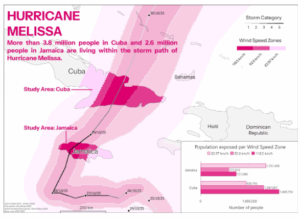
A new peer-reviewed climate analysis has concluded that Hurricane Melissa’s strength was significantly amplified by global warming, with researchers determining that climate change boosted the storm’s wind speeds by about 7% and rainfall by roughly 16%, according to AP News.
Warmer Oceans Fueled Rapid Intensification
The study found that the Atlantic Ocean’s surface temperatures were approximately 1.4°C higher than historical averages when Hurricane Melissa formed — a critical factor that fueled the storm’s rapid intensification. Warmer waters provide more latent heat and moisture, creating the conditions for stronger winds and heavier rainfall during tropical cyclones.
Meteorologists emphasize that while hurricanes are naturally occurring phenomena, human-induced climate change has made them more dangerous by increasing their intensity, duration, and rainfall potential. As a result, tropical storms are becoming slower-moving and wetter, causing greater damage to coastal and island communities.
Severe Damage Across the Caribbean and U.S. Coast
Hurricane Melissa made landfall earlier this year, unleashing catastrophic flooding, infrastructure damage, and widespread power outages across several Caribbean nations before moving toward the U.S. eastern seaboard. Economic losses are estimated in the billions of dollars, with recovery and rebuilding efforts still underway in the hardest-hit regions.
Scientific Consensus on Climate’s Role
Dr. Laura Jenkins, one of the lead authors of the report, said the findings provide further evidence of climate change’s measurable impact on tropical storm behavior:
“The science is clear — warmer oceans are supercharging hurricanes. The connection between climate change and storm intensity is no longer theoretical; it’s observable.”
Her statement reflects a growing scientific consensus that rising global temperatures are directly influencing the frequency and ferocity of extreme weather events worldwide.
Call for Urgent Global Climate Action
Climate experts are urging world leaders to accelerate emission reduction commitments, strengthen disaster preparedness systems, and invest in climate-resilient infrastructure to protect vulnerable populations. As global temperatures continue to rise, scientists warn that storms like Melissa could become the new normal, reshaping coastal risk patterns and challenging existing emergency response frameworks.
“This study should serve as a wake-up call,” Dr. Jenkins added. “We are now living in an era where every fraction of a degree of warming has direct consequences for lives and livelihoods.”
The research underscores the urgent need for coordinated global action to address the escalating risks posed by climate change-driven natural disasters.
